
Back to overview
Aug 19, 2026
Introducing whoranks Reports
Say hello to whoranks Reports. It reviews the posts you published, shows you what your peers did better, and checks whether you actually ran the secret plays recommended.

2 weeks ago we introduces whoranks Analytics, they tell you what happened. Your engagement rate moved, your follower count moved, one post did better than the rest. All of it true, all of it after the fact. The question you actually have on Monday morning is which post to write.
That is the job of the whoranks Report, a new feature dropping today.
Once a month we look at everything you published, compare it against the people you are ranked with, and write you a short briefing on what to do next. The report itself lives in your account under whoranks Reports, together with every report we have written for you before.
You’ll never miss a new report, because you’ll be notified as soon as it is available in your account every month.
The numbers at the top, with the context they need
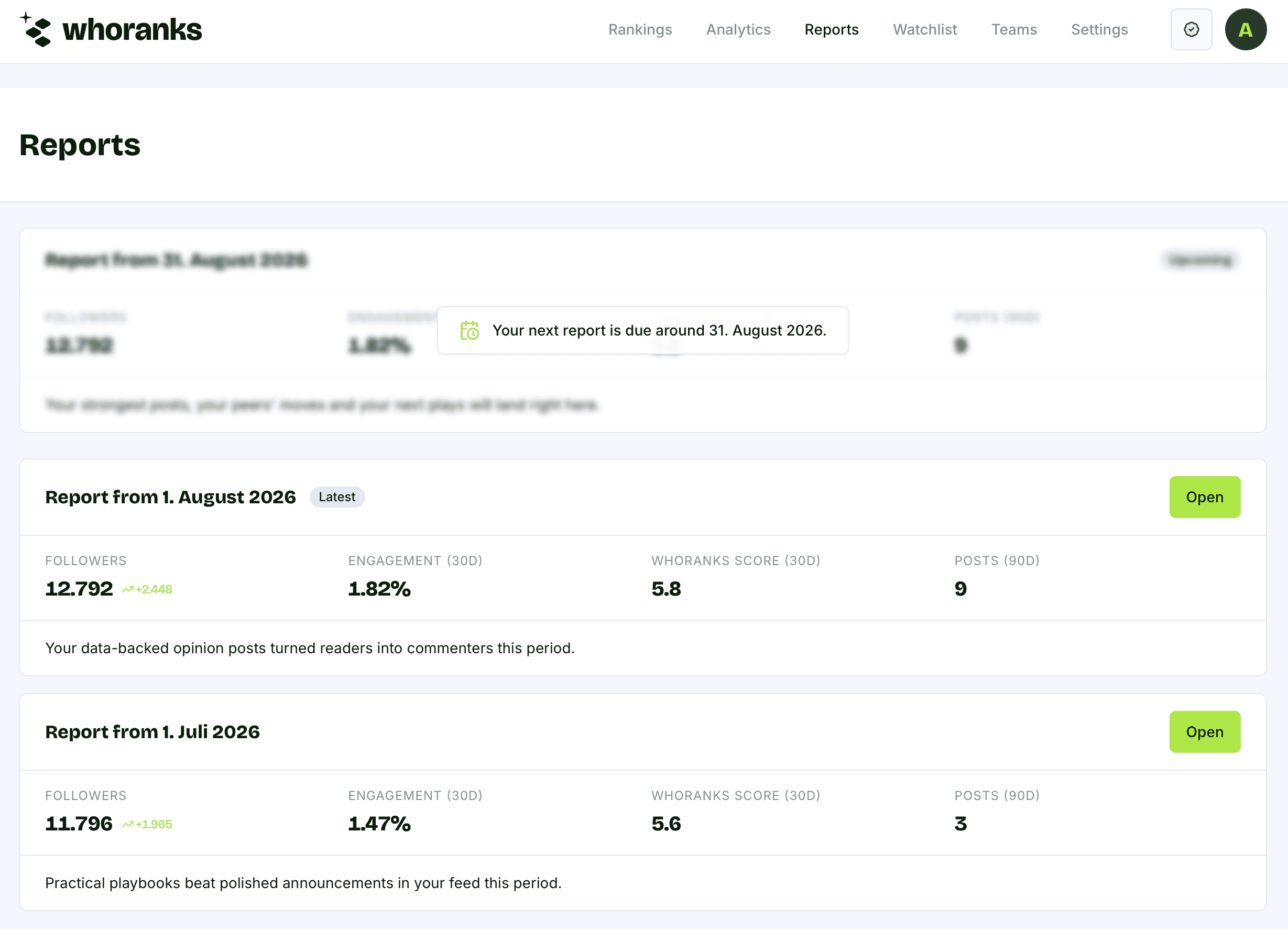
Every report opens with four figures for the period. Followers, engagement rate over 30 days, your whoranks Score over 30 days, and how many posts you published in the last 90 days. Each one carries its change since the last report, so 12,792 followers reads as 12,792 followers and 2,448 more than a month ago. Below that sits your follower curve for the last 90 days.
The whoranks Score is the same score the rankings run on. It reads five things off your profile, which are audience credibility, engagement quality, consistency of presence, shareability, and growth over time. That mix is what lets us put you next to someone with a very different audience size. If you want the long version, we wrote it up in What is the whoranks Score and how to improve it.
Then a bubble chart of your themes. Bigger bubble, more posts touching that theme. It answers a question most people get wrong about themselves, which is what they actually write about. The example report in this post belongs to Anna, a demo account we use for screenshots. Anna thinks of herself as a founder who posts about the journey. Her report shows content strategy taking up most of the space.
After that: four sections, each with one job.
1. We check whether you ran last month’s secret plays
This is the part no dashboard does, and it is the reason the report is worth reading.
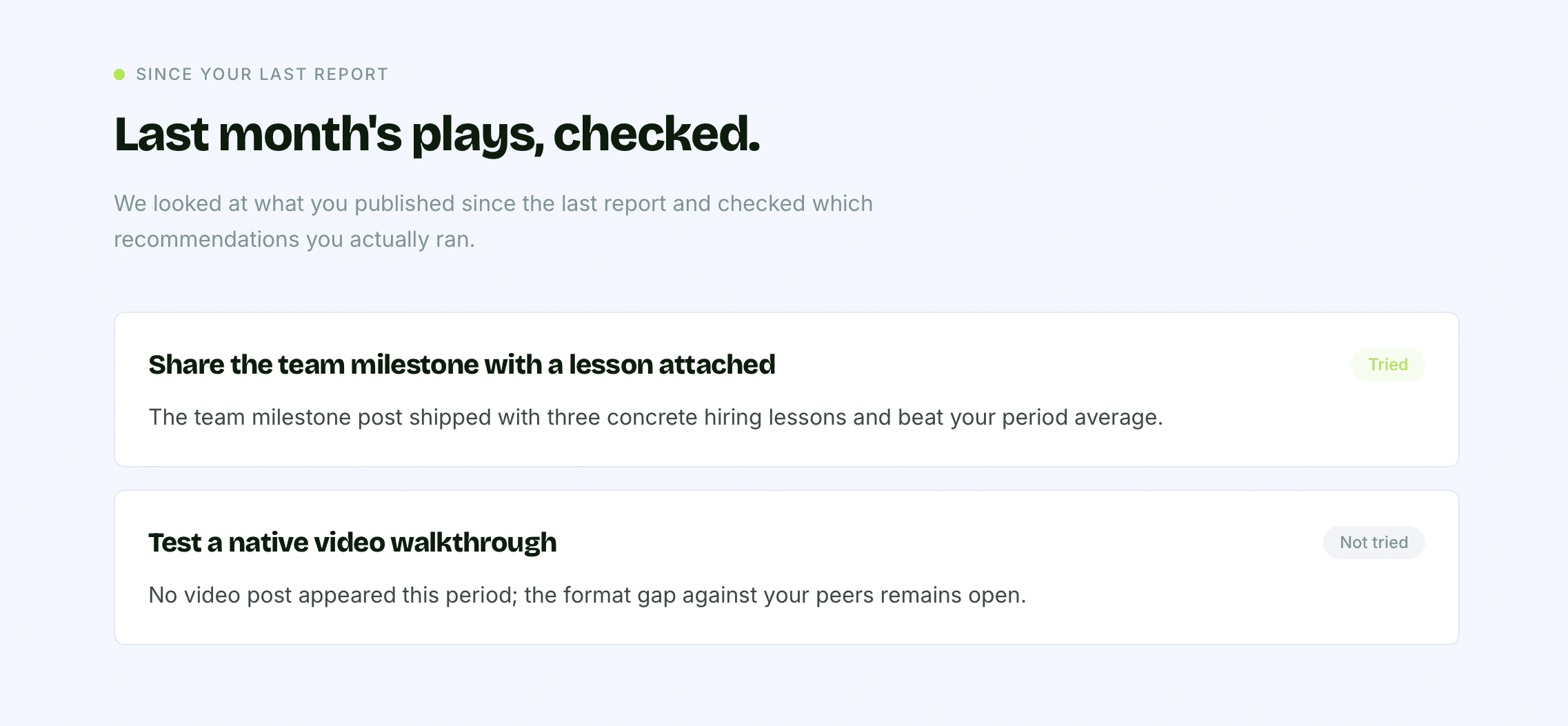
Every report ends with concrete recommendations. The next report opens by going through them one by one and marking each as tried or not tried, with the result attached.
In Anna’s August report it looks like this. We had told her to share the team milestone with a lesson attached. She did, the post shipped with three concrete hiring lessons, and it beat her average for the period. Marked as tried. We had also told her to test a native video walkthrough. No video post appeared in the period, so it is marked as not tried, and the format gap against her peers is still open.
Two things happen here. You find out whether the advice was any good, and we find out too. A recommendation that gets ignored three months in a row is a bad recommendation or a badly explained one, and the report makes that visible instead of quietly repeating it.
It also means the reports get better the longer you use them. The first one you get is a snapshot. The third one knows what you have already tried, what you keep avoiding, and what worked when you did it.
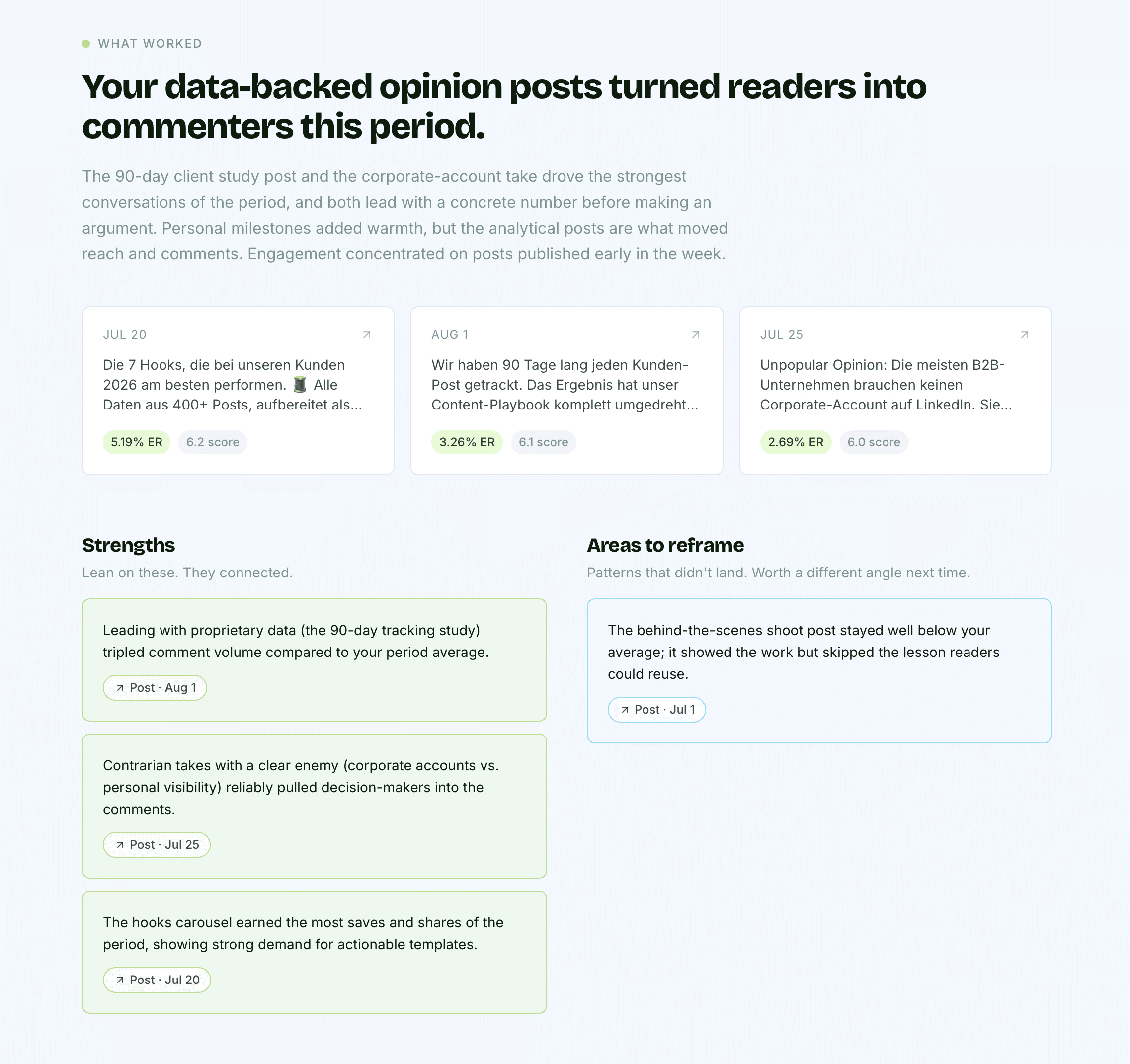
2. What worked, and the reason it worked
The second section takes your three strongest posts of the period and explains the mechanic behind them.
Anna’s top post ran at 5.19% engagement with a score of 6.2. The report does not stop at the number. It names why the post landed, which was proprietary data from a 90 day tracking study that tripled her comment volume compared to her average for the period. Her second strongest post took a contrarian position with a clear opponent, corporate accounts against personal visibility, and pulled decision makers into the comments. Her hooks carousel earned the most saves and shares of the period, which says there is demand in her audience for templates they can apply.
The same section names what fell short. Anna’s behind the scenes snapshot stayed well below her average, and the report says why. It showed the work and skipped the lesson readers could reuse. That is a fixable problem, and phrasing it as a reframe rather than a failure is deliberate. The post was worth writing. It needed one more paragraph.
3. The peer gap
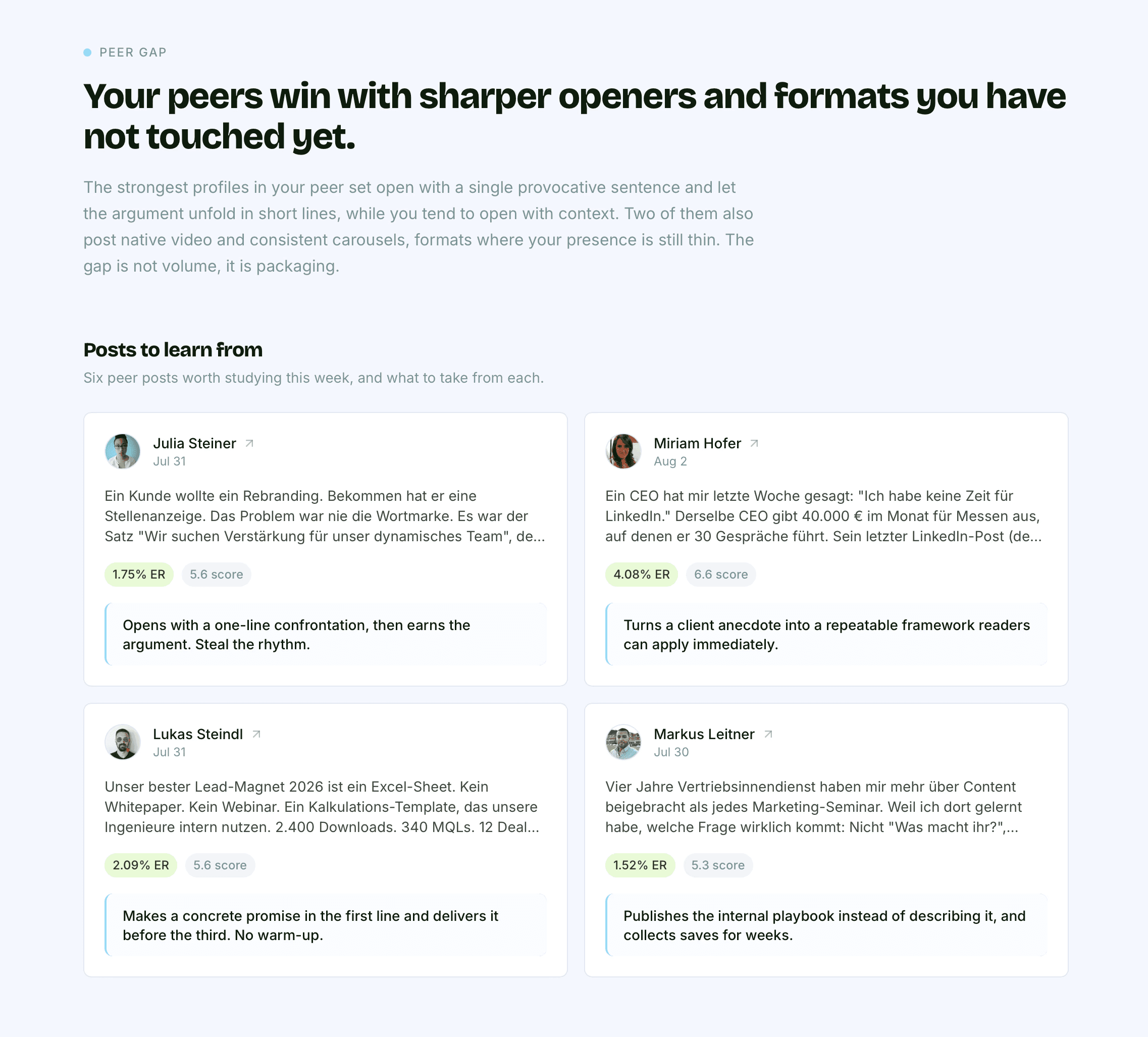
You are ranked against a specific set of people. The report pulls six of their posts from the same period and tells you what to take from each one.
Real posts, with their engagement rate and score, and one line on the technique behind each. One peer opens with a one line confrontation and then earns the argument over the next three lines. Another turns a client anecdote into a repeatable framework readers can apply immediately. A third makes a concrete promise in the first line and delivers it before the third, with no warm up.
The advantage her peers hold sits in packaging rather than volume. Two of them also post native video and consistent carousels, formats where Anna’s presence is still thin.
4. Your next move
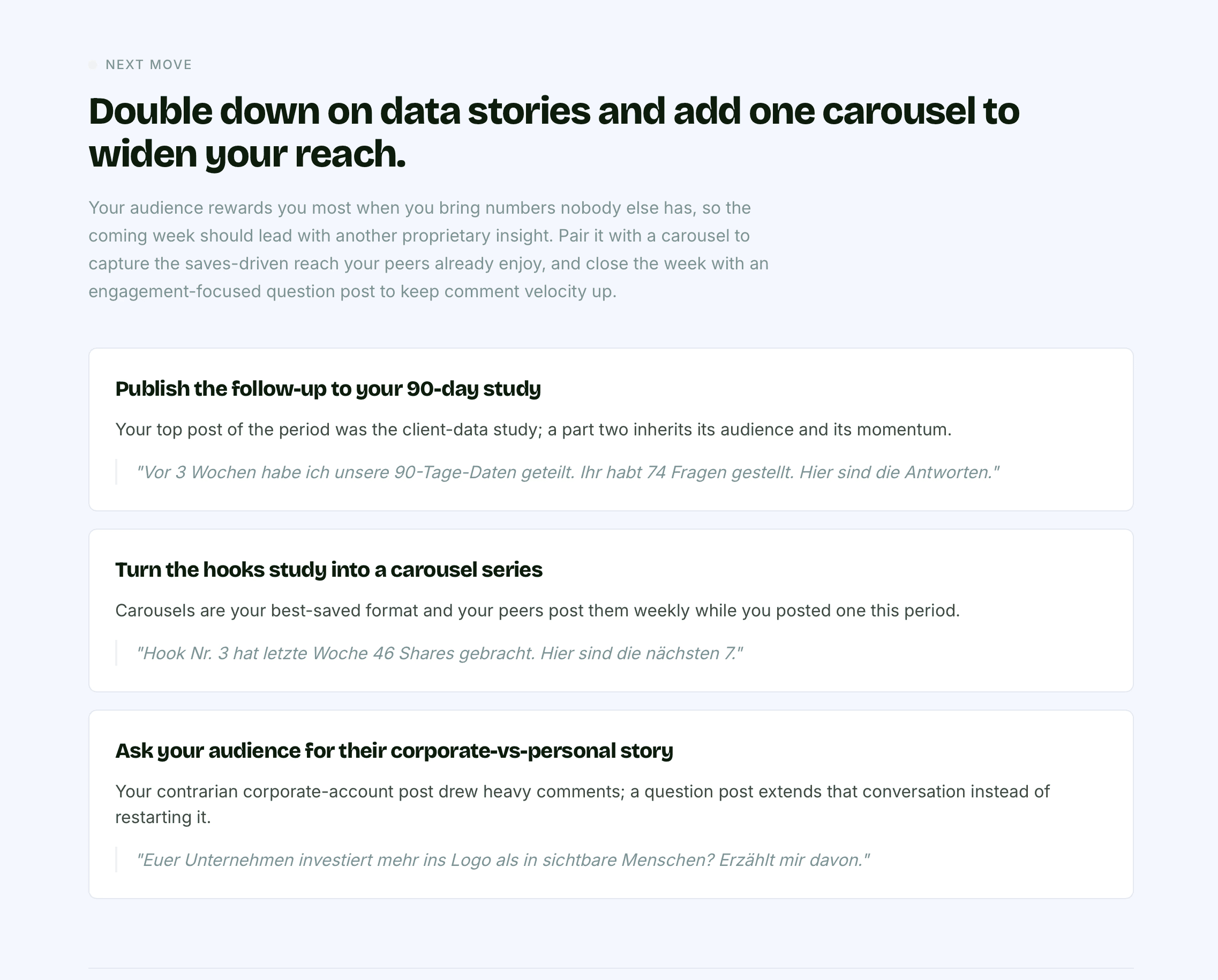
The last section is three plays for the coming weeks, and each one comes with a hook you can use.
Anna’s report tells her to publish the follow up to her 90 day study, because her best post of the period was the client data story and part two inherits its audience and its momentum. Underneath sits the opening line, ready to post. “Vor 3 Wochen habe ich unsere 90-Tage-Daten geteilt. Ihr habt 74 Fragen gestellt. Hier sind die Antworten.”
The second play turns her hooks study into a carousel series, which pairs the format her audience saves most with the format her peers use and she published once. The third asks her audience for their own corporate versus personal story, since her contrarian post drew comments and a question post extends that conversation instead of restarting it.
Three plays, in priority order, each with a reason and a first line. The distance between reading the report and publishing something is about as short as we can make it.
How to actually use it
Open the report the day the email arrives and read it in one sitting.
Then take one thing from section four into your drafts. Not all three. One, the one at the top, because it is there for a reason.
Next month, section one will tell you what it did.
Pro tip: Paste the whole report into your AI agent and have it build your content strategy from there. Every prompt of that kind usually fails on missing context, and the report is exactly the context that was missing. Your real numbers, the posts that worked and the reason they worked, what the people around you in the ranking do differently, and three plays with hooks already written.
Something like this gets you a long way:
“Here is my monthly LinkedIn report from whoranks. Build me a four week posting plan that runs the three plays in priority order, keeps the strengths listed under what worked, and fixes the weakness named under areas to reframe. One post per idea, with the hook written out.”
From there you can ask it for five variations of a hook, or hand it a draft you already have and ask whether it matches the strengths your report named. The output stops sounding generic the moment the agent can read your last month. And this is important to further increase engagement rate and the whoranks Score. Generic AI slop won’t do your ranking and brand any good.
Who this is for
Anyone posting on LinkedIn with some regularity. The report works off what you publish, so it gets sharper the more you give it. If you posted twice in the last quarter, the first report will be thin and honest about it.
whoranks Reports go live on 19 August. On the Free plan you get three of them. On the Personal Brand plan you get one every month for as long as you are on it, which is the setup the whole thing is built around, because section one only exists once there is a previous report to check against.
Your reports live in your account under whoranks Reports, and we email you every time a new one is ready.
The first report gives you a plan. The second one tells you whether you ran it.
Want to see your own report? Login to your account to find the secret insights.